


Key Takeaways
- Originals are proprietary games developed in-house and available only on this platform.
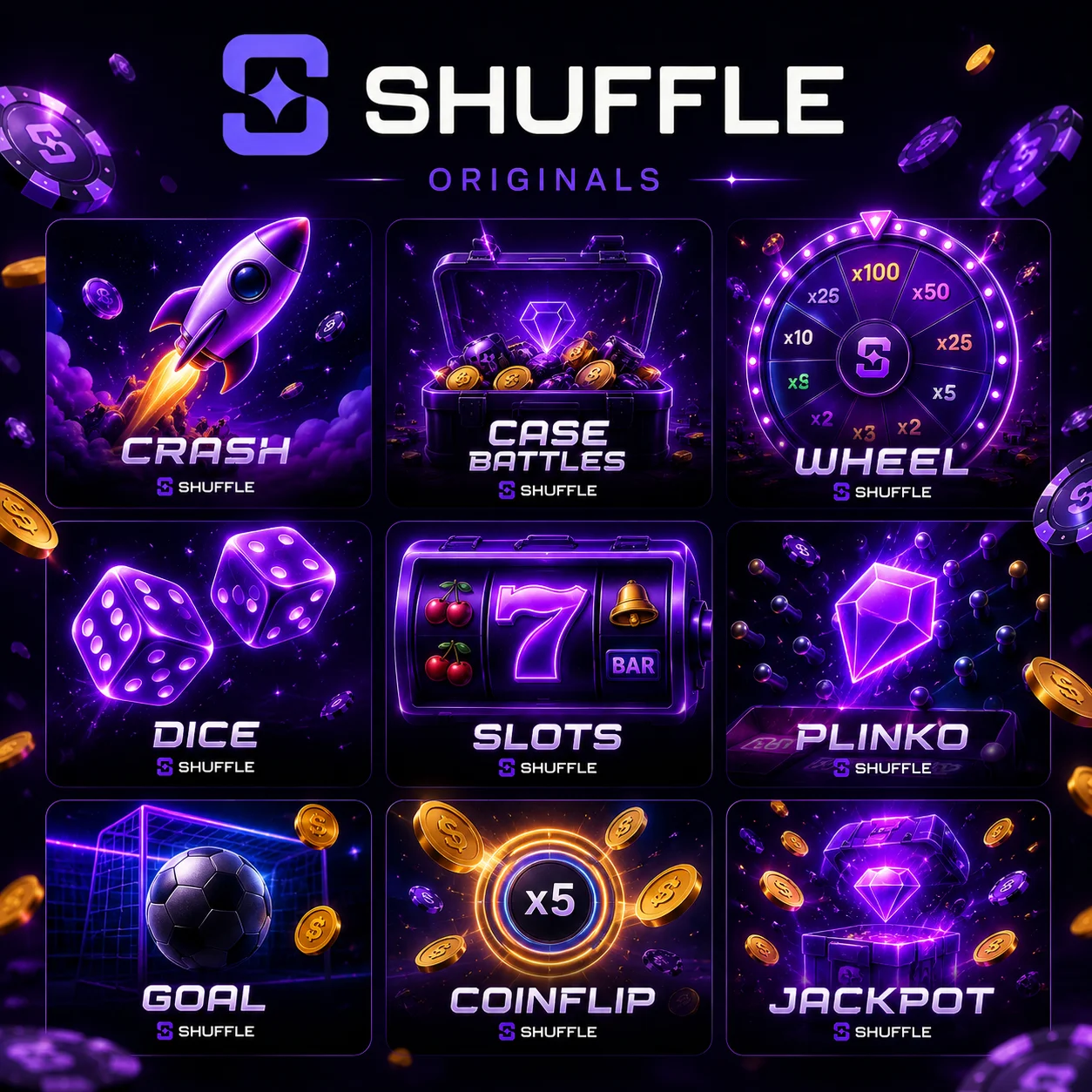
- The collection includes Crash, Plinko, Dice, Mines, Limbo, Keno, Hilo, and Video Poker.
- Every title uses a Provably Fair system based on a pre-generated chain of 10 million SHA-256 hashes.
- Rounds complete in seconds, making these games suited for fast-paced sessions and multiplier-based strategies.
What Makes an Originals Games Shuffle Casino Title Different
The core distinction between originals games Shuffle Casino titles and standard provider content comes down to three areas: ownership, transparency, and pace.
Ownership – every game is built and maintained by the platform’s internal development team. Updates, balancing, and new features do not depend on a third-party release schedule.
Transparency is another defining feature of the Shuffle app casino experience. All proprietary titles operate on the Provably Fair protocol. A pre-generated chain of SHA-256 hashes means each round’s outcome exists before the game starts and can be verified by the player after the round ends. Standard provider slots use RNG certification instead, which is audited externally but not individually verifiable per spin.
Pace – rounds last seconds rather than minutes. There are no loading screens between spins, no lengthy bonus animations, and no waiting for other players. The result appears immediately after the action is confirmed.
These characteristics make the Originals section a distinct product category rather than a reskin of existing mechanics.
Categories Inside the Shuffle Casino Originals Collection
The Originals library groups titles by gameplay format. Some prioritize speed and simplicity, while others center on multiplier escalation and risk management.
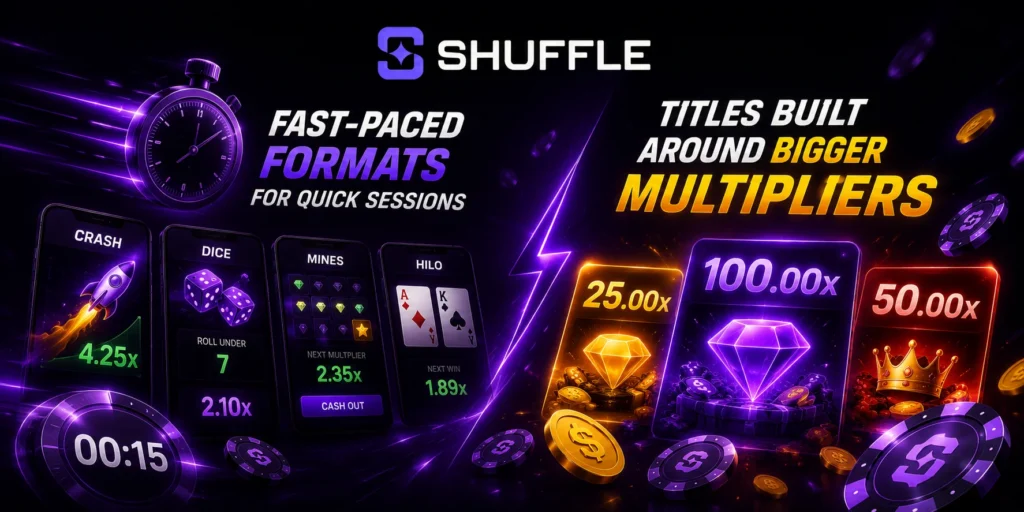
Fast-Paced Formats for Quick Sessions
Several Originals are designed for players who want rapid results without complex rules:
- Dice – predict whether the result of a roll lands above or below a target number. Adjust the target to shift the odds and payout ratio.
- Mines – uncover tiles on a grid while avoiding hidden mines. Each safe tile increases the multiplier; cash out at any point or risk the next reveal.
- Keno – select numbers from a board and watch the draw. Payouts scale with how many of your picks match the drawn numbers.
- Hilo – guess whether the next card in the sequence is higher or lower than the current one. Each correct guess raises the multiplier.
- Video Poker – a single-hand draw poker format where you choose which cards to hold after the initial deal.
Each game resolves within seconds, with no qu
Titles Built Around Bigger Multipliers
A separate group of Originals focuses on escalating multipliers where the potential payout grows the longer the player stays in a round:
- Crash – a multiplier rises continuously from 1.00x after the round starts. Players decide when to cash out; if the multiplier crashes before they exit, the bet is lost. The house edge is 1%.
- Plinko – a ball drops through a pyramid of pegs and lands in one of several slots at the bottom, each assigned a different multiplier. The distribution of outcomes depends on the number of rows selected.
- Limbo – set a target multiplier before the round begins. If the generated result meets or exceeds the target, the bet pays out at that multiplier. Higher targets offer larger payouts but lower probability.
These titles appeal to players comfortable with higher variance. The key mechanic in each ca
How Fairness Is Verified in Every Shuffle Casino Original
Every title in the Shuffle Casino originals games collection uses the Provably Fair system. The platform pre-generated a chain of 10 million hashes before any rounds were played. Each hash corresponds to one round, and the chain is issued in reverse order – so every result already exists before the player places a bet.
The verification method relies on SHA-256 hashing. Each hash in the chain is derived from the one that follows it. If any single result were altered, the entire chain would fail verification because the modified hash would not produce the correct predecessor. Players can check any past round by entering the hash into the public verification tool available on the platform and on GitHub.
This system differs from standard RNG certification used by third-party providers. While RNG audits confirm fairness at the system level, Provably Fair lets each player verify each individual round.